Holding the Ball – Prior Opportunity
28 February 2024
Holding the Ball
Holding the Ball – Prior Opportunity is one of four types of holding the ball. It is paid when a player has had prior opportunity and fails to immediately kick or handball the ball.
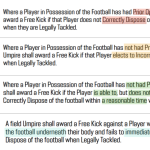
A player who has had Prior Opportunity must immediately kick or handpass the ball. If they do not, they will be penalised “Holding the Ball – Prior Opportunity”.
So what is Prior Opportunity? The laws of the game tell us that this is when a player:
- is balanced and steady
- attempts to evade or fend
- has taken a mark or been awarded a free kick
- has driven their head into a stationary or near stationary opponent
Examples
https://www.loom.com/share/19c3412e8180467e853f55060f1dea28
- The Frankston YCW player takes the mark and clearly plays on over his mark. This is considered a prior opportunity. He is legally tackled by the Mt. Eliza player and because he does not dispose of the ball by hand or foot is correctly penalised for holding the ball.
- The Frankston YCW player clearly has a prior opportunity to dispose of the ball before being correctly tackled by the Dromana player. The prior opportunity is constituted by being balanced and steady and the fact that he had an opportunity to give the ball off.
- The Karingal player has a prior opportunity to dispose of the ball, electing not to before being correctly tackled by the Somerville player. A correct Holding the Ball decision is paid.
- In this example the Rye player is balanced and steady and is tackled correctly. As he does not kick the ball he is correctly penalised for Holding the Ball.
- This is a borderline Holding the Ball but one that I am happy to tick off as correct. It is important to note that the ruckman is entitled to take the ball out of the ruck. This does not constitute prior opportunity, however. In this instance the Rosebud player has the opportunity to handball the ball, but elects not to and is correctly tackled by the Sorrento player.
- Another borderline decision but correctly applied. The Sorrento player evades a tackle constituting prior opportunity. He is then correctly tackled by his Rosebud opponent and the ball is not disposed of immediately. Holding the ball is paid.
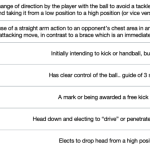
Here are 3 of the 7 cues we use for determining whether a player has had prior opportunity:
Evade
A player is considered to have had Prior Opportunity if they have attempted to evade an opponent. This includes a player who:
- Raises the ball from low to high (or high to low) to keep their arms free of a tackle
- Changes direction to avoid a tackle
- Attempts to spin to avoid a tackle
Fend
A ‘fend’ is an attacking move – the use of a straight arm to resist the tackle being made.
A ‘brace’ is an immediate reaction to a tackle and is not prior opportunity.
Balanced and steady
A player is considered to have had Prior Opportunity if they are balanced and steady.
A guide for ‘balanced and steady’ by a running player is 3 steps – however this is only a guide.